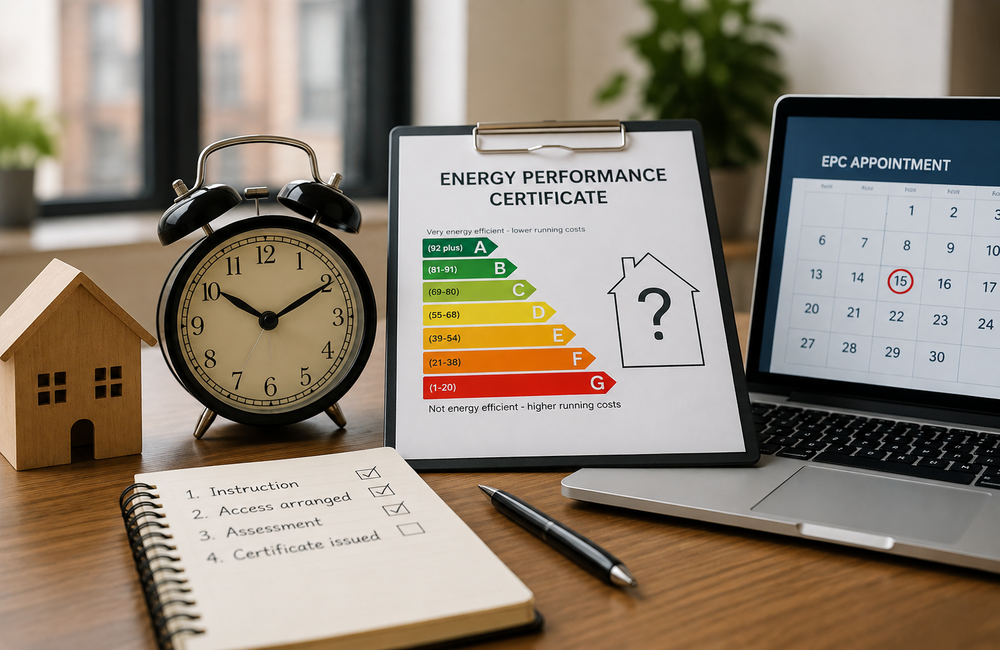
When an EPC is delayed, it is easy to assume that the assessment itself is taking longer than expected. In practice, the site visit may only take a relatively short time and, for a straightforward property, the certificate can often be produced soon afterwards. More commonly, time is lost before the assessor arrives or while they are trying to gather the information needed to complete the assessment properly.
For estate agents, this distinction matters because how long an EPC takes does not depend solely on finding an assessor who can attend quickly. The whole process needs to move smoothly from the initial instruction through to arranging access, completing the assessment and issuing the certificate. Where information is missing or communication breaks down between these stages, even a relatively simple EPC can become a source of unnecessary delay.
The EPC process is often viewed as one straightforward task: an assessor visits the property, completes the assessment and issues the certificate. Although that broadly describes what happens, it overlooks the coordination required before, during and after the visit.
Before an appointment can be confirmed, the assessor needs the correct property details, a clear understanding of what has been instructed and a suitable way to arrange access. They may also require information or evidence relating to the insulation, glazing, heating systems, lighting or previous improvement works at the property.
Where any of this is missing, the assessment cannot always move forward immediately. This becomes particularly common when several people are involved in the process. An agent may be communicating with an owner, landlord, tenant, occupier, building manager or keyholder, while the assessor is waiting for the necessary confirmation to finalise the booking. The assessment may be ready to proceed, but the arrangements surrounding it are not.
One of the easiest places to lose time when considering how long an EPC takes is immediately after it has been instructed. An email may contain the property address but no contact information, details of the property type or explanation of the access arrangements. The assessor then needs to request this information before they can begin arranging the visit.
Each individual query may only create a small delay, but the time can quickly add up. Where the owner or occupier can only be contacted through the agent, a simple booking may require several rounds of emails and telephone calls before an appointment is finally agreed.
This is not usually the fault of any one person. Estate agency teams are busy, instructions move quickly and the EPC may be one of many tasks being handled at the same time. However, when the instruction process is informal, there is a greater chance that important information will be missed. Providing a complete instruction at the outset gives the assessor the best opportunity to arrange the appointment without unnecessary follow-up.
For many EPCs, arranging access is the most time-consuming part of the process. An empty property with keys held at the branch may be relatively straightforward, but an occupied home, tenanted commercial unit or managed building can require considerably more coordination.
The occupier may only be available at certain times, the landlord may need to approve the visit, or a commercial tenant may need to arrange for someone to meet the assessor. Access may also be required to plant rooms, roof areas or shared spaces that are not normally available to the occupier.
Where communication passes through several people, every stage takes longer. The assessor contacts the agent, the agent contacts the owner, the owner speaks to the tenant and the proposed appointment is then passed back through the same chain. By the time a response reaches the assessor, the original appointment may no longer be available.
Allowing the EPC provider to communicate directly with the relevant contact can remove much of this back-and-forth. The agent remains in control of the instruction and can continue to receive updates, but no longer needs to act as the intermediary for every practical detail relating to the appointment.
Access is not the only issue that can delay an EPC. The assessor also needs enough information to understand the property and record its features accurately. Some elements can be confirmed visually during the site visit, while others may require documentary evidence.
For a domestic property, this may include evidence of insulation, glazing replacements, heating-system upgrades or improvements that are concealed from view. For a commercial building, the assessor may need specifications for lighting, heating, cooling or ventilation systems, particularly where equipment has changed since the previous assessment.
If this information is not available during the visit, the assessor may need to request it afterwards, creating an additional gap between the inspection and the certificate being issued. There may also be circumstances where the evidence cannot be obtained at all. In these cases, the assessor must apply the appropriate default assumptions rather than crediting an improvement that cannot be verified.
Collecting evidence early therefore has two benefits. It can shorten the time between the site visit and lodgement, while also helping to ensure that improvement works already completed at the property are reflected in the assessment wherever possible.
The site visit is only one part of producing an EPC. Once the assessor has left the property, they still need to review the information collected, complete the relevant calculations and resolve any areas of uncertainty.
For a simple property, this work can often be completed quickly. More complex buildings may require further review, particularly where there are multiple building services, mixed uses, unusual construction details or incomplete information. Once the assessment has been completed, the certificate must also be lodged before it becomes formally available.
A fast turnaround should not mean treating this work as an administrative formality. The aim should be to complete the assessment efficiently while still taking the time needed to understand the property correctly. The most reliable way to achieve this is to remove delays around the assessment rather than attempting to rush the assessment itself.
A genuinely efficient process begins with understanding how long an EPC takes from the point the instruction is first received. The assessor should be provided with the correct address, property type, contact details and any relevant access information from the outset. Where an owner, tenant or occupier needs to be contacted, permission for direct communication can also be supplied immediately.
Where improvement works have previously been carried out, it is also helpful to ask whether supporting information is available before the assessment takes place. This gives the owner or agent time to locate invoices, specifications, photographs or other evidence rather than searching for it after the visit.
None of these steps is particularly complicated, but together they address several of the most common reasons for delay. The assessor can spend their time completing the assessment rather than repeatedly chasing information that could have been provided earlier.
For estate agents, much of the frustration associated with EPCs comes from the coordination involved. The initial instruction may take only a few minutes, but the follow-up can include arranging appointment dates, confirming access, answering practical questions and keeping the client informed.
Where the EPC provider takes responsibility for this communication, the process becomes easier to manage. The seller, landlord or occupier has a clear point of contact, the assessor can resolve practical questions directly and the agent can receive progress updates without having to oversee every stage personally.
This is particularly valuable for agents working across both domestic and commercial property, where access requirements can vary considerably between instructions. Clear responsibility for the booking process reduces confusion and makes it easier to identify and resolve any issues before they become significant delays.
The simplest way to avoid last-minute pressure is to treat the EPC as part of the normal property instruction process. The first step should be to check whether a suitable certificate is already in place. Understanding when a domestic or commercial EPC is required can also help agents identify the requirement early. Where a new assessment is required, it can then be arranged alongside photography, floor plans, property particulars and other early marketing activity.
Starting the process at this stage provides more time to arrange access and gather any evidence relating to previous improvements. It also reduces the risk of the EPC becoming an urgent task immediately before the property is due to go onto the market.
For commercial properties, an early check may also identify whether the existing rating could raise questions during the letting or transaction process. For domestic properties, it gives the seller more time to resolve access arrangements and provide information about any work completed to the home. In both cases, identifying the requirement early makes it easier to manage.
Estate agents need confidence that an EPC will progress promptly once it has been instructed, but speed should come from an organised process rather than a reduction in the quality of the assessment.
A rushed site visit, incomplete evidence or poor communication may result in a certificate being issued sooner in the very short term, but it can also create problems later. Relevant improvements may not be reflected in the rating, questions may remain unresolved or further assessment work may be required.
A more dependable approach is to remove the preventable delays around the assessment. Complete instructions, clear access arrangements, direct communication and early evidence collection all make it possible to deliver a careful assessment within a sensible timeframe.
Estate agents cannot control every element of a property transaction, but they can reduce the number of preventable issues that affect how long an EPC takes. A well-managed EPC service should take ownership of the stages between instruction and certificate issue, reducing the need for repeated follow-ups and giving owners, tenants and occupiers a clear point of contact.
At R2G, we support agents with both domestic and commercial EPCs. We can arrange appointments directly with owners or occupiers, collect the information needed for the assessment and keep the agent updated as the instruction progresses.
Our aim is to provide a fast turnaround without treating the certificate as a box-ticking exercise. Most of the time lost on an EPC does not arise during the site visit itself. It occurs in the gaps between instruction, access, assessment and lodgement. Managing those gaps properly is what keeps the process moving.
The timescale depends on the property, assessor availability and how quickly access can be arranged. For many straightforward properties, the assessment and certificate can be completed within 48 hours. Delays are more likely to arise while arranging access or gathering missing information.
The instruction should include the full property address, property type, relevant contact details and any important access information. It is also helpful to provide information or evidence relating to previous improvements where available.
Access may need to be agreed between the agent, owner, landlord, tenant, occupier or building manager. Where communication passes through several people, confirming a suitable appointment can take longer than the assessment itself.
Yes, where the agent or client has agreed that direct communication is appropriate. This can reduce unnecessary back-and-forth while allowing the agent to remain informed about progress.
The assessor may need to review the information collected, complete the calculation or obtain supporting evidence. More complex properties may also require additional checks before the certificate can be lodged.


© 2025 R2G LIMITED. All rights reserved | Website by Creativefive | Company number: 15826171 | Registered address: The Office, Gothic House, Barker Gate, Nottingham NG1 1JU | info@r2g.co.uk