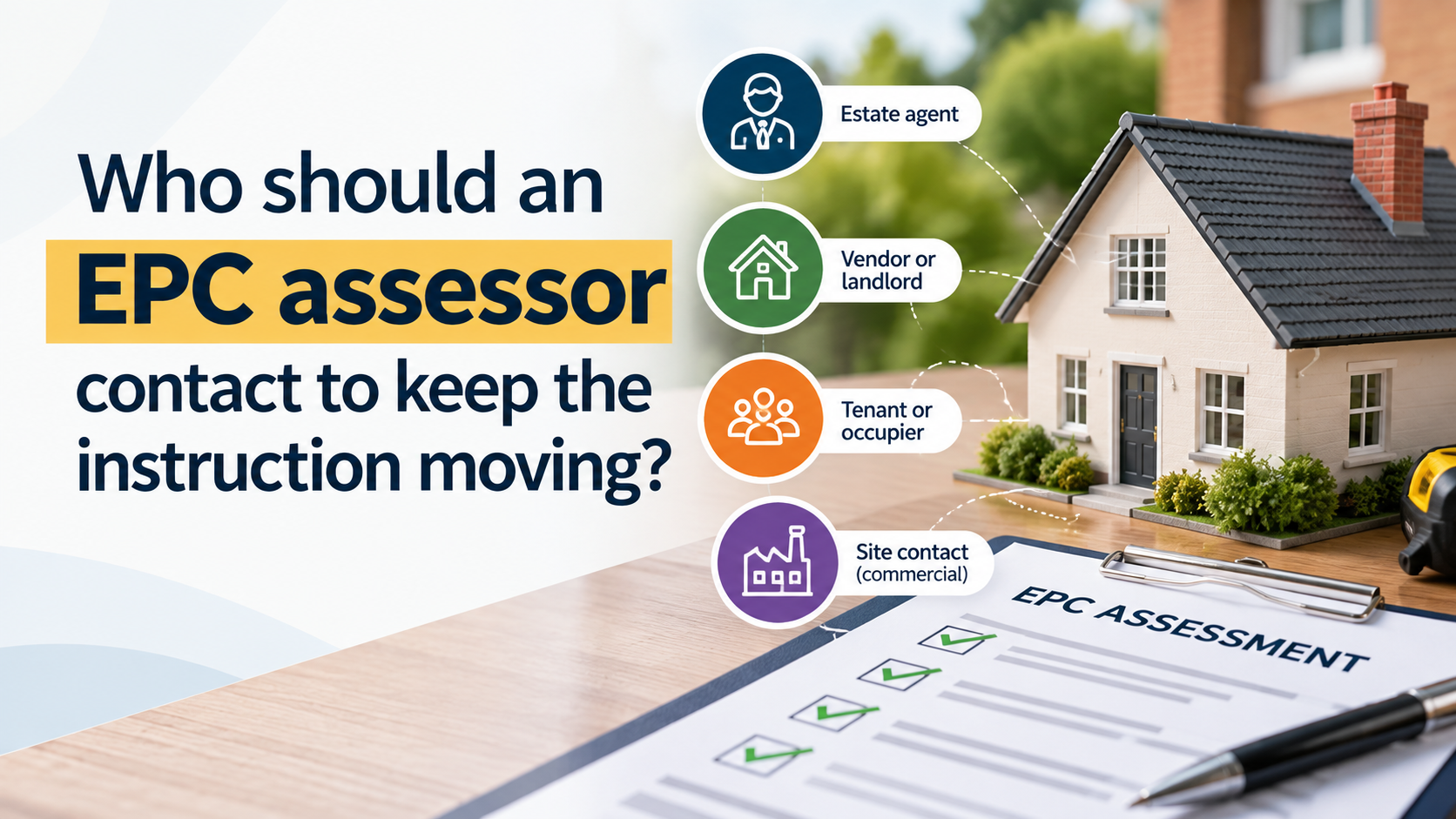
There is no single person an EPC assessor should always speak to. The right contact depends on the property, who controls access and what information is needed to complete the assessment properly.
For some instructions, it makes sense for the estate agent to remain the main point of contact throughout. In other cases, the process will move much more quickly if the assessor can communicate directly with the vendor, landlord, tenant, occupier or someone responsible for the site.
The important thing is to agree the communication route at the beginning. Where every appointment option, access query and evidence request has to pass through the branch, the agent can quickly become the middleman in a process they do not need to manage in detail. A better approach is to identify who is best placed to deal with each part of the instruction while keeping the agent informed of progress.
The most useful contact for an EPC assessor is generally the person who can answer the immediate question or take the next action.
If keys are held at the branch, that person may be the estate agent. If the property is occupied, it may be the tenant who needs to agree a suitable appointment. Where information is required about insulation, replacement windows, heating upgrades or previous improvement works, the vendor or landlord may be better placed to help.
Commercial properties can involve further contacts. A facilities manager, building manager or site representative may understand the access procedures and be able to open plant rooms, service cupboards, roof areas or other restricted spaces.
The person who instructed the EPC will not always be the same person who can provide access, and the person meeting the assessor may know very little about the property’s construction or building services. A well-managed instruction recognises this and directs each question to the person most likely to resolve it.
There are many situations where it is sensible for the estate agent to coordinate the instruction. A vacant property with keys held at the branch is probably the clearest example. The agent can confirm when the keys are available, provide any relevant access notes and manage the process without involving the vendor unnecessarily.
The branch may also need to remain the main contact where the client relationship is sensitive or where communication with the owner, tenant or occupier needs to be managed carefully. In some cases, the agent will already hold all the necessary information and can arrange the appointment immediately.
The purpose of direct communication is not to remove the estate agent from the process. It is simply to avoid involving the branch in routine arrangements where another person can provide an answer more quickly.
The vendor or landlord is often the best source of information about the property itself. They may know when windows were replaced, whether insulation has been installed, what heating upgrades have taken place or whether other alterations have been completed.
This can be particularly useful where improvements are concealed or cannot be confirmed through a visual inspection alone. Without suitable evidence, the assessor may not be able to reflect those improvements in the assessment.
The owner may also be the most practical person to arrange the appointment, particularly where they live at the property or intend to attend the visit. Routing every exchange through the agent can turn a simple conversation into several separate messages. The assessor proposes a date, the branch contacts the owner, the owner suggests an alternative and the response then travels back through the same route.
Allowing the EPC assessor and owner to communicate directly removes several stages from the process while still allowing the agent to receive the relevant updates.
For an occupied property, the tenant or occupier is often the person who can actually make the appointment happen. They know when they will be available, whether access is restricted at certain times and whether there are any practical considerations the assessor needs to be aware of.
During a domestic EPC, the tenant may need to ensure that the EPC assessor can access every room, the loft and other relevant areas. For a commercial assessment, the occupier may need to arrange the visit around working hours, customers, deliveries or operational requirements.
However, the tenant may not be able to answer every question about the building. They may not know when improvements were made, who installed them or whether particular systems are the responsibility of the landlord.
The tenant can therefore be the right contact for access without necessarily being the right contact for property information or supporting evidence.
Commercial buildings often have more complicated access arrangements than domestic properties. The assessor may need to inspect plant rooms, service areas, roofs, communal spaces or equipment that is not under the control of the person occupying the main unit.
Reception or security may require advance notice, while a building manager may need to approve the visit or arrange for someone to accompany the assessor. Even where the tenant can provide access to the occupied space, they may be unable to open areas controlled by the landlord or building management team.
Contacting the wrong person does not always prevent an appointment from being booked, but it can mean that the assessment cannot be completed fully when the EPC assessor arrives. Identifying the practical site contact before the appointment reduces the risk of restricted access, repeat visits and delays to the certificate.
Estate agents can easily become the communication link between everyone involved in an EPC instruction. The assessor provides available dates, the branch passes them to the vendor or tenant and the response then travels back through the agent.
The same process may be repeated for parking arrangements, keys, site procedures, evidence requests, access restrictions or appointment changes. None of these tasks is especially difficult in isolation, but across a number of live instructions the administration can build quickly.
The agent may also have little direct knowledge of the practical issue being discussed, which means they are passing questions between two people rather than resolving them. Where direct contact is suitable and has been agreed, a shorter communication route is generally more efficient for everyone.
Although the agent does not need to manage every practical detail, they still need to know what is happening with the instruction.
Direct communication should reduce the branch’s workload without leaving the team out of the loop. The agent should know whether the relevant contact has been reached, when the assessment has been booked and whether there are any access or evidence issues that could cause a delay.
They should also be told when the certificate is expected and when their help is genuinely required. This does not mean copying the branch into every email or providing an update after every telephone call. It means sharing useful information at the points where it affects the progress of the instruction.
The EPC provider can take ownership of the practical coordination while the agent retains oversight of the work.
Communication is much easier when the different roles are established at the outset. At the point of instruction, it is useful to identify who should remain the main client contact, who can arrange access, who can provide information or evidence about the property and who needs to receive progress updates.
These roles may all be handled by the same person, but they do not have to be. A domestic instruction might involve the branch, the vendor and a tenant. A commercial property could also include the landlord, occupier, facilities manager, building manager and security team.
Clarifying these responsibilities at the beginning helps prevent questions being directed to the wrong person and reduces the chance of the booking stalling. It also gives everyone involved a clearer understanding of what they need to provide.
At R2G, we support estate agents with both domestic and commercial EPC instructions. Where appropriate, we communicate directly with vendors, landlords, tenants, occupiers and site contacts to arrange access and collect the information required for the assessment.
We agree the communication route with the agent at the start and keep the branch informed as the instruction moves forward. Where the agent needs to remain the main contact, we work through them. Where direct communication will make the process easier, we take responsibility for the routine coordination.
The aim is to reach the right person without creating unnecessary work for the estate agent. An EPC assessor does not always need to speak to one contact throughout the process. They need to speak to the person who can move each part of the instruction forward.
The best contact is usually the person who can deal with the immediate requirement. This may be the agent for keys, the tenant for access, the landlord for property information or a site manager for restricted commercial areas.
The agent may remain the main contact where they hold the keys, manage a sensitive client relationship or already have the information required. In other cases, direct contact with the owner or occupier may make the process quicker.
Yes, provided this communication route has been agreed. The tenant is often the most practical person to arrange an appointment for an occupied property.
The owner or landlord is often best placed to provide invoices, specifications, photographs or other evidence relating to previous works. The tenant may be able to arrange access but may not know the property’s full history.
Commercial assessments may require communication with the landlord, occupier, facilities manager, building manager or site security. The correct contact depends on who controls the areas and systems that need to be inspected.


© 2025 R2G LIMITED. All rights reserved | Website by Creativefive | Company number: 15826171 | Registered address: The Office, Gothic House, Barker Gate, Nottingham NG1 1JU | info@r2g.co.uk