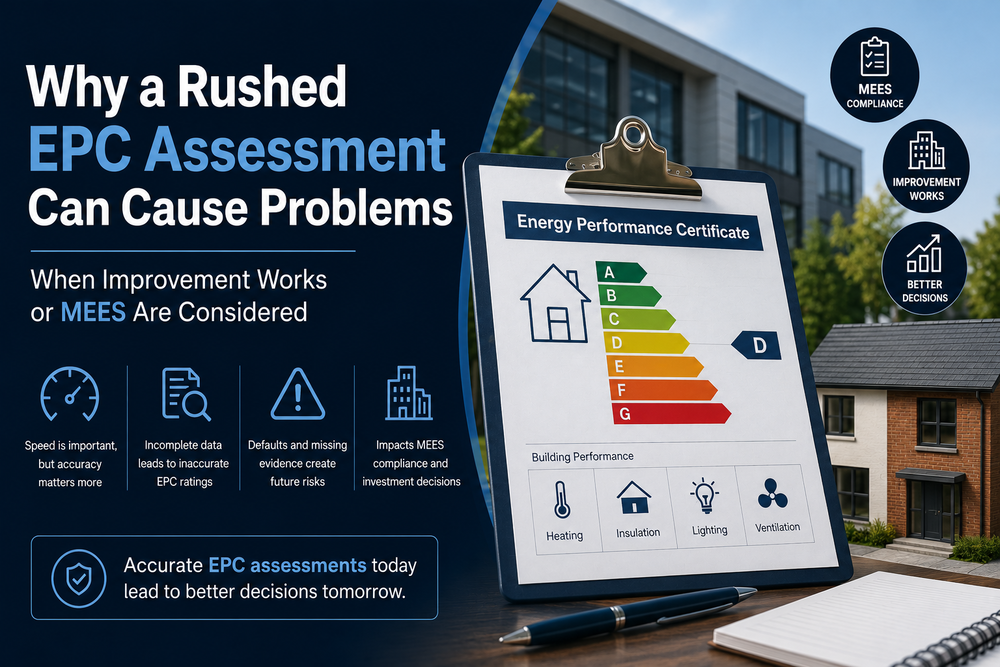
When a property needs an EPC assessment quickly, it is understandable that turnaround time becomes the immediate priority. The property may be ready to market, a tenancy may be progressing or a transaction may be waiting for the certificate before it can move forward.
In those circumstances, the main question is often how soon the EPC assessment can be completed and the certificate issued. However, a fast certificate is only useful if the assessment behind it has been completed properly. Where important information is missed, evidence is not collected or the building is not understood in sufficient detail, the consequences may not become clear until much later.
By that point, the EPC may be being used to inform decisions about Minimum Energy Efficiency Standards, planned improvement works or future investment. What initially appeared to be a routine administrative task can then create uncertainty, additional cost and further work.
Turnaround time is important. Estate agents and property owners need confidence that an instruction will be dealt with promptly and will not delay marketing, a letting or wider plans for the property.
However, speed is only one part of a good EPC assessment service. The assessor still needs to understand the property, review the relevant systems and collect enough evidence to support the rating. This applies to both domestic and commercial buildings.
A straightforward property may be assessed quickly without any difficulty. More complicated buildings may require greater care, particularly where they have been extended, altered, divided into different areas or improved over a number of years.
If the assessment is rushed purely to meet a short deadline, important details can be overlooked. The certificate may still be issued, but the information behind the rating may not be as complete or useful as it could have been.
An EPC assessment is only as reliable as the information used to produce it. The assessor must record the construction, heating, cooling, lighting, glazing, insulation and other relevant characteristics of the property.
Some of this can be confirmed visually during the site visit. Other information may depend on product specifications, invoices, photographs or evidence of previous works. Where there is not enough time to ask questions or review the available information, the assessor may have to rely solely on what can be seen during the appointment.
This does not necessarily mean that the resulting certificate is incorrect. It can, however, mean that the EPC does not capture the property as fully as it might have done.
Improvement works may have been completed but remain concealed from view. Insulation could have been installed without any accessible record, or a commercial lighting upgrade may not be supported by sufficient product information. Where these details cannot be verified, the assessor may be unable to include them in the calculation.
The improvement itself may still be performing as intended, but the EPC cannot recognise something that cannot be evidenced.
Energy assessments use a combination of observed information and recognised assumptions. Where a feature cannot be confirmed, the assessor may need to apply the appropriate default value.
These assumptions are necessary because it is not practical or appropriate to open up every part of a building during an EPC assessment. The issue arises when defaults are used simply because there was not enough time during the EPC assessment to obtain evidence that may have been available.
This can leave the property owner with a rating that does not fully reflect improvements already carried out. It may also make it more difficult to understand why the property received a particular result.
That becomes increasingly important when the EPC is used as the starting point for a wider discussion. An owner may want to understand how the property can be improved, an agent may need to explain the rating to a landlord or buyer, or an asset manager may be reviewing energy performance across a portfolio.
Where the underlying information is incomplete, each of these conversations becomes more difficult.
For many property owners, an EPC becomes more significant when Minimum Energy Efficiency Standards need to be considered. At that stage, the question is no longer simply whether a valid certificate exists.
The rating may influence whether further action is required, which properties present the greatest risk and where investment should be prioritised. Before making those decisions, the owner needs confidence that the EPC provides a fair representation of the building.
Where an assessment was rushed, that confidence may be missing. The owner may need to gather evidence retrospectively, request further clarification or commission another review to establish whether the original rating can be relied upon.
This introduces additional cost and delay at the point when a clear compliance position is most important. Instead of beginning with a reliable understanding of the property, the MEES discussion begins with questions about the quality of the original information.
An EPC may also influence decisions about future improvement works. Its recommendations may be used as an initial guide, while the current rating may help shape a more detailed plan for improving the building.
If the assessment does not accurately reflect the property, that starting point can be misleading. The owner may spend time investigating measures that are not the most appropriate priority or fail to recognise improvements that have already been completed but were not captured in the calculation.
There is also a risk of assuming that an individual measure will improve the rating in isolation without considering how it interacts with the rest of the building. This is particularly relevant in commercial properties, where heating, cooling, ventilation and lighting systems may affect one another.
Domestic properties can present similar issues where extensions, heating upgrades and insulation works have been completed at different times. A useful improvement plan needs reliable information about the existing building before sensible recommendations can be made.
Where the original EPC data is incomplete, the property may need to be reviewed again before any informed investment decisions can be taken.
The immediate objective of an EPC instruction is usually to obtain the certificate. Once it has been lodged, the task may appear complete.
However, the consequences of a weak assessment often emerge later. The owner may question why completed works are not reflected in the rating, while the agent may receive queries from a landlord, buyer or tenant. A contractor reviewing future improvements may discover that the available information is incomplete, or a compliance decision may be delayed because no one is confident that the existing certificate provides a reliable starting point.
The property may then require another visit, additional evidence or a more detailed technical review. This is particularly frustrating where the original assessment saved only a small amount of time, but the later uncertainty creates significantly more work.
A careful EPC does not need to become a lengthy process. Fast turnaround and accuracy are not opposing aims, provided the instruction is managed properly.
The assessor should receive complete property details at the start, access should be arranged in advance and the owner or occupier should be asked whether relevant improvement works have been carried out. Where supporting evidence exists, it can be provided before the visit or shortly afterwards.
This allows the EPC assessment to progress efficiently without relying unnecessarily on assumptions. It also gives the assessor an opportunity to identify any missing information while there is still time to resolve it.
The aim is to spend time in the right places. A small amount of care at the assessment stage can prevent repeated visits, later disputes and uncertainty when the EPC is used to support more significant property decisions.
At R2G, we understand that agents and property owners often need EPCs completed quickly. Our aim, however, is not simply to issue the certificate at the earliest possible moment.
We take the time to understand the property, review the available evidence and ensure that previous improvements are reflected where they can be properly verified. This approach applies across both domestic and commercial EPCs.
It helps to produce a certificate that remains useful beyond the immediate marketing or transaction requirement. Where MEES, future improvement works or wider property decisions arise later, the owner has a stronger and more reliable starting point.
A good EPC should arrive promptly, but it should also reduce uncertainty rather than create further problems once the certificate has been issued.
Yes. Fast turnaround and accuracy are compatible where the assessor receives complete information, suitable access and any available supporting evidence. Problems arise when the assessment itself is rushed or important details are overlooked.
Some improvements cannot be confirmed through a visual inspection alone. Without acceptable evidence, the assessor may be unable to reflect insulation, glazing, lighting or system upgrades in the calculation.
An incomplete or weak assessment can create uncertainty when a landlord later reviews MEES risk or improvement options. Further evidence, modelling or reassessment may then be needed before confident decisions can be made.
Not necessarily. The effect of an improvement can depend on the wider property, the product installed and the information used in the assessment. Proposed works should be considered against the building as a whole.
A further assessment may be needed where the original information was incomplete, evidence becomes available or substantial alterations have been made. It may also be appropriate before significant investment decisions are taken.


© 2025 R2G LIMITED. All rights reserved | Website by Creativefive | Company number: 15826171 | Registered address: The Office, Gothic House, Barker Gate, Nottingham NG1 1JU | info@r2g.co.uk