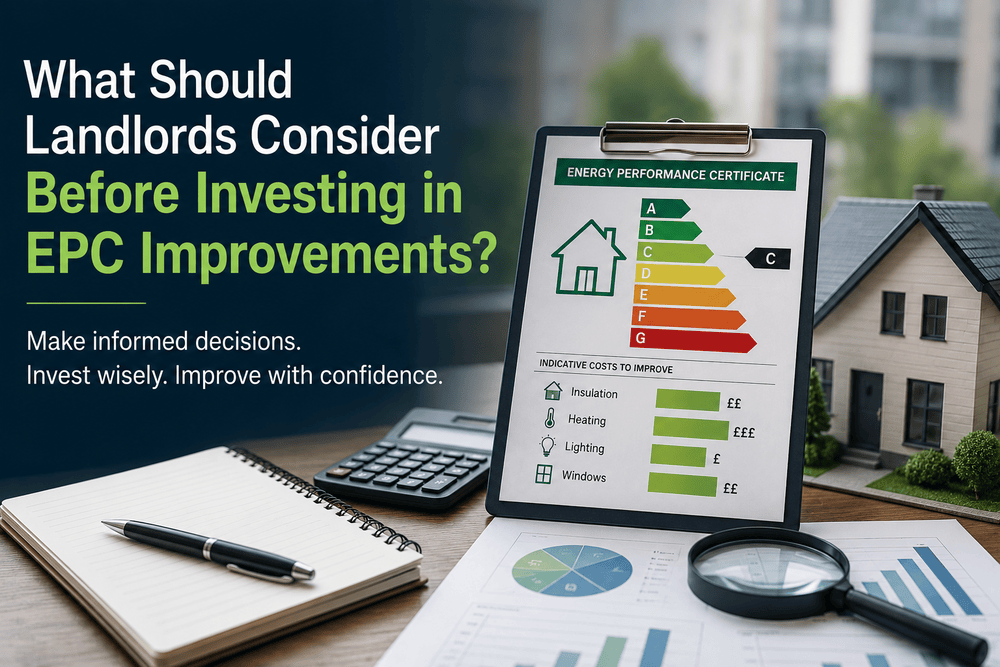
Improving an EPC rating can involve anything from a relatively simple change to a significant programme of works. For landlords, the difficult part is not always identifying possible improvements, as the EPC may already include a list of recommendations. The more important question is whether those recommendations represent the right use of money for the property.
A measure may improve the rating while still offering poor value. Another may appear expensive when considered on its own but make sense when combined with planned maintenance or refurbishment. In some cases, the current EPC may not fully reflect work that has already been completed.
Before committing budget to improve an EPC rating, landlords need to understand the starting point, define what they are trying to achieve and consider how the work could realistically be delivered.
The first question should be whether the existing EPC reflects the property accurately. Before investing in improvements, it’s worth understanding why an accurate and up-to-date EPC is so important. An EPC is based on the information available to the assessor at the time. Some features can be confirmed during the site visit, while others require supporting evidence.
If insulation, glazing, lighting or heating improvements have already been completed but cannot be verified, they may not be fully reflected in the rating. This means a landlord could begin planning new work before establishing whether the existing building has been recorded properly.
For a domestic property, this may relate to concealed insulation, replacement windows or heating upgrades. For a commercial property, it could include lighting specifications, controls, ventilation systems or alterations made during a tenant fit-out.
Reviewing the current assessment alongside the available evidence can therefore be a sensible first step. The objective should be to understand whether physical work is genuinely required rather than assuming that every improvement must begin with new expenditure.
Not every landlord is working towards the same outcome. The immediate priority may be to improve the EPC rating to meet a minimum standard, but there may also be wider objectives around reducing energy use, supporting a sale or letting, protecting asset value or preparing for future requirements.
These objectives can lead to different decisions. The quickest route to a particular rating may not provide the best long-term value, while a measure that reduces actual energy consumption may have only a limited impact within the EPC calculation. A landlord intending to hold the property for many years may also take a different approach from one preparing the asset for sale.
It is therefore important to define what success looks like before comparing improvement options. The aim may be to reach a particular rating at the lowest practical cost, reduce operating costs for the tenant, improve the overall quality and marketability of the property or create a longer-term programme that avoids repeated work later.
Without that clarity, it is difficult to judge whether one recommendation is genuinely better than another.
Cost is important, but it should not be considered in isolation. A cheaper measure may produce very little improvement, while a more expensive option may deliver a larger rating change, reduce maintenance requirements or align with work that is already planned.
Landlords should consider the likely impact of each measure, the cost of delivery and the wider value it may create. That value may come from lower energy use, improved comfort, reduced compliance risk, stronger marketability or avoiding the need to return to the same part of the building later.
The comparison should also take account of uncertainty. Some measures have a relatively predictable effect, while others depend heavily on the existing building fabric, systems and pattern of use. This is particularly important in commercial properties, where several systems may interact and changes in one area can influence the wider assessment.
The best-value route is not necessarily the cheapest recommendation on the list. It is the option, or combination of options, that produces the strongest outcome against the landlord’s actual objective.
A technically valid recommendation is not always a practical one. The property may be occupied, the lease may restrict what the landlord can access or alter, and the work may require tenant consent, service interruptions or temporary loss of space.
For domestic landlords, even relatively simple improvements can involve several visits and careful coordination with the tenant. In commercial properties, works may affect trading hours, specialist equipment, shared services or areas controlled by the occupier.
There may also be physical constraints. The construction of the building may make a proposed measure more complicated than the recommendation suggests, plant space may be limited or existing systems may need to be replaced together rather than individually.
These issues should be considered before quotations are requested or designs are developed. A measure that looks attractive in the EPC model may become poor value once access, disruption and enabling works are included.
Practicality is therefore not a secondary consideration. It forms part of deciding whether a recommendation is suitable in the first place.
Improvement measures rarely exist in isolation. Some depend on others being completed first, while others are easier and more cost-effective to deliver alongside maintenance, refurbishment or lease events.
An insulation measure may make more sense when the roof or external finish is already being replaced. Heating changes may need to follow work that reduces demand, while lighting and controls may be easiest to address during a tenant fit-out.
The order in which work is completed can have a significant effect on both cost and disruption. If measures are delivered in the wrong sequence, the landlord may pay twice for access, finishes or enabling work. A later project may also interfere with or undo an earlier one.
A clear plan should therefore distinguish between measures that can be completed now and those that should be aligned with future works. It should also identify where further investigation is needed before a decision is made.
In some cases, the right first step will not be installation. It may be gathering evidence, testing an assumption, confirming responsibility under the lease or commissioning a more detailed survey.
Before spending money on physical improvements, landlords should consider whether the current rating is being held back by missing information. The assessor may have had to apply defaults where evidence was unavailable, which could relate to insulation, glazing, heating performance, lighting efficiency or previous improvement works.
Where reliable evidence exists, reviewing it may change the understanding of the property without changing the building itself. This does not mean that every rating can be improved through paperwork, as the evidence must still be valid, relevant and acceptable for the assessment.
However, it is worth checking before significant expenditure is approved. There is little value in paying to repeat work that has already been completed or investigating measures on the basis of an incomplete starting point.
A common risk is assuming that completing one recommendation will automatically produce a particular EPC result. In reality, the impact may depend on several factors.
The measure may interact with other parts of the assessment, the existing building information may be incomplete or the product installed may differ from the specification assumed during early modelling.
Landlords should therefore understand how much confidence can be placed in the projected improvement. The option should ideally be modelled against the current property, using known specifications where possible. It should also be clear whether the expected outcome depends on further evidence and whether there is enough margin in the plan to allow for a small variation.
These questions become particularly important where the landlord is making a compliance decision or committing substantial capital. The aim is not to promise a result that cannot be guaranteed, but to reduce uncertainty as far as possible before the money is spent.
The best route is rarely to complete every recommendation listed on the EPC. Some measures may be unsuitable, others may offer limited value and some may be better delivered later. In certain cases, a combination of smaller improvements may be more practical than one major intervention.
An improvement plan should help filter these options. It should explain which measures are worth considering, why they have been prioritised and what needs to happen before they can be delivered.
It should also connect the EPC rating to the wider reality of the property, including the tenant, the lease, planned maintenance and the landlord’s longer-term objectives. This gives the owner a clearer basis for making a decision rather than simply providing another list of possibilities.
At R2G, we help property owners understand the current EPC before moving into improvement planning. We review the available evidence, assess potential measures and consider their likely cost, value and practical delivery.
For occupied properties, we also account for tenant access, operational disruption and the opportunities created by planned works or lease events.
Our aim is not to recommend the greatest possible number of improvements. It is to identify a prioritised route that makes sense for the property and gives the owner greater confidence before committing budget.
The key question is not simply how money can be spent to improve an EPC rating, but how it can be spent effectively.
The landlord should first confirm that the current EPC reflects the property accurately and that any previous improvements have been supported by suitable evidence.
No. Some recommendations may offer limited value, be unsuitable for the property or make more sense when combined with future maintenance or refurbishment.
Yes. Where an improvement cannot be verified, the assessor may need to apply an appropriate default rather than reflecting the work in the calculation.
They should consider cost, likely rating impact, energy savings, disruption, access, maintenance benefits and how well the measure supports the wider objective for the property.
Potential measures can often be assessed against the existing property to estimate their likely effect. The reliability of the result will depend on the quality of the available building information and product specifications.
The result may differ where building information is incomplete, the installed specification changes or the measure interacts with other parts of the assessment. This is why the level of certainty should be considered before committing significant expenditure.


© 2025 R2G LIMITED. All rights reserved | Website by Creativefive | Company number: 15826171 | Registered address: The Office, Gothic House, Barker Gate, Nottingham NG1 1JU | info@r2g.co.uk