Survey programmes are often judged by what happens at the property. Was the survey completed, was the right information collected and was the output returned on time?
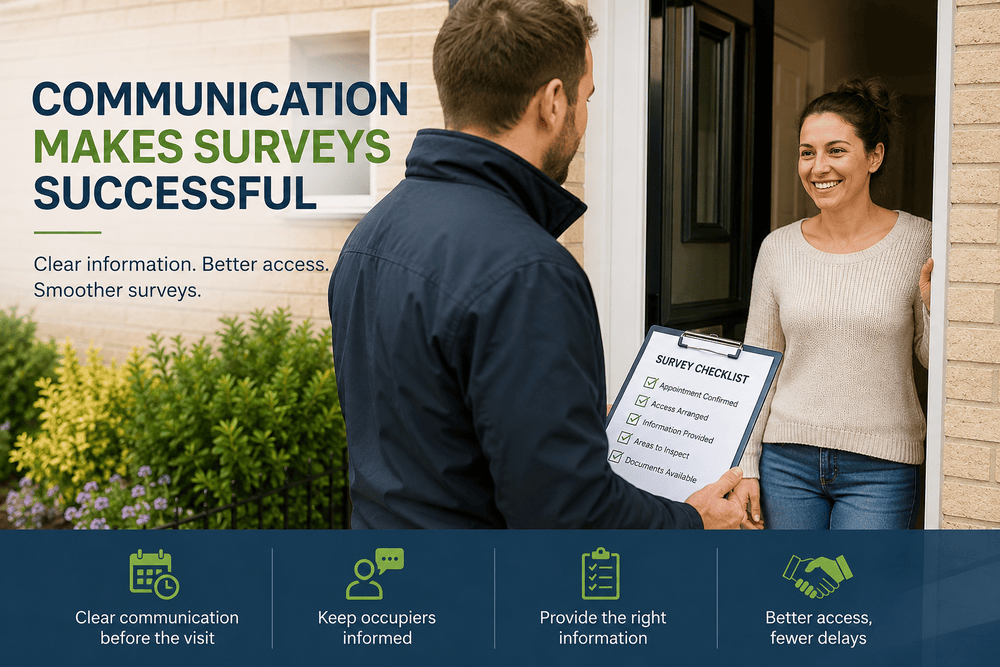
All of those things matter, but the success of the visit often depends on communication that begins well before the surveyor arrives and continues after they leave. Clear communication makes appointments easier to arrange, helps occupiers prepare and gives surveyors a better chance of gaining the access they need.
Where communication is poor, even a technically straightforward survey can become difficult. For contractors working on behalf of property owners, that can lead to failed visits, repeat appointments and delays across the wider programme. EPC timings can also be affected by access and information issues.
A successful survey does not begin at the front door. It begins when the appointment is first introduced to the resident, tenant, occupier or site contact.
They need to understand who is attending, why the survey is required and what they are expected to do. Where this is unclear, the occupier may not recognise the company name, understand how the contractor and survey provider are connected or feel confident that the visit is genuine.
These concerns are understandable, particularly where the person attending is from a different organisation to the one that originally made contact. A clear introduction reduces that uncertainty before it affects the appointment.
People are more likely to cooperate with a survey when they understand why it is taking place. A resident who is simply told that someone needs to inspect the property may worry that there is a problem, assume work has already been approved or question why photographs and measurements are required.
For a commercial property, the site contact may need to know whether the survey covers the whole building, one unit or particular building systems.
The explanation does not need to be highly technical. It should simply cover the purpose of the visit, its likely duration, the areas that may need to be accessed and whether any information or documents should be available.
This gives the person at the property enough information to prepare and allows the appointment to proceed more smoothly.
A failed visit does not always mean that nobody was present. The surveyor may reach the property but still be unable to complete the work.
The occupier may not have realised that every room needed to be accessible, a facilities contact may not have arranged entry to a plant room or a tenant may have expected the landlord to attend with keys.
There may also be uncertainty around the appointment itself. The occupier may have received a date but no time window, or know the name of the property owner without recognising the company carrying out the survey.
In many cases, the problem is not an unwillingness to cooperate. The person at the property has simply not been given enough information to make the visit work.
Communication also needs to flow towards the surveyor. Before attending, they should have the correct address, contact details and access instructions.
They may also need information about parking restrictions, key collection, security procedures, lone working considerations or areas that require separate permission.
For commercial buildings, this could include plant rooms, roof areas, shared spaces or parts of the property controlled by another occupier or management team. For domestic properties, the surveyor may need to know about lofts, extensions, outbuildings or other areas that require preparation.
Good information cannot prevent every problem, but it reduces the number of surprises waiting at the property.
Once the survey begins, the surveyor still needs to communicate clearly. The person providing access may not understand why certain questions are being asked or why particular areas need to be inspected.
A brief explanation can help them understand why photographs are required, why measurements are being taken and why information about previous works may be relevant.
This is particularly important in occupied homes, where the surveyor is entering someone’s personal space. Professional and respectful communication helps build trust and makes it more likely that the assessment can be completed fully.
The same principle applies in commercial properties, where staff may be continuing their normal work around the survey.
Even with good preparation, surveys do not always go exactly as planned. A room may be locked, a plant area may require another contact or the property may have been altered since the instruction was issued.
When this happens, the surveyor needs a clear route for escalating the issue. A quick response from the contractor, property owner or programme contact can sometimes prevent a second visit.
A manager may be able to authorise access, a housing officer may provide another telephone number or the contractor may confirm whether a particular area is essential to the survey.
Without that support, a relatively small issue can result in a partial or failed appointment.
Surveyors should not need to work out who to call when an issue arises. There should be clear contacts for access, programme and technical queries.
The same applies to occupiers. They should know who to speak to if they need to rearrange the visit, ask a question or raise a concern.
Where responsibility is unclear, messages can move between several organisations without anyone taking ownership. The property owner assumes the contractor is managing it, the contractor assumes the survey provider has spoken to the resident and the resident contacts a general office that cannot see the appointment.
A defined communication route makes the process easier and reduces the risk of important updates being missed.
Communication should continue once the surveyor leaves. The contractor or property owner needs to know whether the survey was completed successfully and whether anything remains outstanding.
There may be documents to obtain, photographs to review or areas that require a further visit. The surveyor may also identify an issue that affects the proposed work or needs further investigation.
The sooner this is reported, the sooner the programme team can respond. A delay of a few days may not seem significant for one property, but unresolved items can quickly build into a backlog across a larger programme.
A clear completion update helps prevent this.
Recording a failed survey simply as “no access” is rarely enough. The wider team needs to know what actually happened.
Nobody may have been present, access may have been refused, keys may have been unavailable or only part of the property may have been inaccessible. The appointment information may also have failed to reach the right person.
Each cause requires a different response. If the reason is not recorded properly, the survey may be rearranged without anything changing and fail again for exactly the same reason.
Clear feedback allows the contractor or property owner to address the cause rather than simply rebook the visit.
Contractors need more than confirmation that surveys are being attempted. They need a clear view of progress, including how many visits are booked, completed, awaiting information or requiring intervention.
This helps the wider team focus on the properties where support is needed and makes delays visible before they affect planned works.
Without clear reporting, unresolved properties can remain in the background while the rest of the programme moves forward. By the time the issue is identified, the delay may already be affecting delivery targets.
A communication gap that appears minor on one property can become significant across 50, 100 or 500. A small percentage of failed visits can represent a large number of wasted journeys, while repeated chasing can absorb considerable administrative time.
At scale, communication needs to form part of the survey services delivery process rather than being treated informally around it. This means consistent appointment messages, clear contact routes, defined escalation points and reliable reporting after each visit.
The aim is not to eliminate every problem. Some occupiers will still cancel, some properties will remain difficult to access and some surveys will identify unexpected issues. The important thing is that those situations are dealt with quickly and consistently so they do not delay the wider programme unnecessarily.
Good communication supports the delivery of effective survey services at every stage. Before the visit, it prepares both the occupier and the surveyor. During the appointment, it helps build trust and resolve issues. Afterwards, it gives the contractor and property owner a clear understanding of what has been completed and what still needs attention.
The practical results are fewer wasted journeys, less chasing, better access and more complete surveys. For contractor partners, this reduces the risk of the survey programme holding up the work that follows.
At R2G, we provide survey services across domestic and commercial properties. This includes coordinating appointments, communicating with residents, tenants and site contacts and ensuring surveyors have the information they need before attending.
Where an issue arises on site, we can escalate it quickly and record the reason clearly if the visit cannot be completed. We also provide programme updates so contractors can see what is booked, completed, outstanding or awaiting further action.
The aim is not simply to send surveyors to properties. It is to manage the communication around each visit so that more appointments succeed and the wider programme continues to move forward.
They should know who is attending, why the survey is taking place, how long it may take, which areas require access and whether any information needs to be prepared.
The occupier may not have access to every area, keys may be unavailable or a plant room may require separate permission. Clear preparation helps reduce these problems.
The surveyor should receive the correct address, contact details, access instructions and any relevant information about keys, parking, security procedures or restricted areas.
Clear explanations help occupiers understand why photographs, measurements and access to particular areas are required. This supports trust and makes it easier to complete the survey fully.
The surveyor should have a clear route for escalating access, programme or technical questions. A quick response may allow the issue to be resolved without arranging another visit.
The contractor or property owner should be told whether the visit was completed and whether any evidence, investigation or further access is required.


© 2025 R2G LIMITED. All rights reserved | Website by Creativefive | Company number: 15826171 | Registered address: The Office, Gothic House, Barker Gate, Nottingham NG1 1JU | info@r2g.co.uk