I had the pleasure of attending Wimbledon last week. Tennis is a sport I’ve always respected, but never really followed closely. After spending a day there, I completely understand why people love it. The atmosphere was incredible (and yes, joining the infamous Queue at 3:30am was absolutely worth it). The sun was shining, the Wimbledon grounds were buzzing and, seeing the action up close, you really appreciate just how fast the game is.
With Wimbledon in full swing and the football World Cup dominating my evenings, it got me thinking about sustainability in sport. More importantly, it got me thinking about what businesses can learn from it.
When we think about sustainability in sport, it’s easy to picture solar panels on stadium roofs or electric vehicles transporting athletes. While these certainly have their place, some of the most impressive innovations are much simpler. They’re about using resources more efficiently, changing behaviours and finding value in things that would otherwise be thrown away.
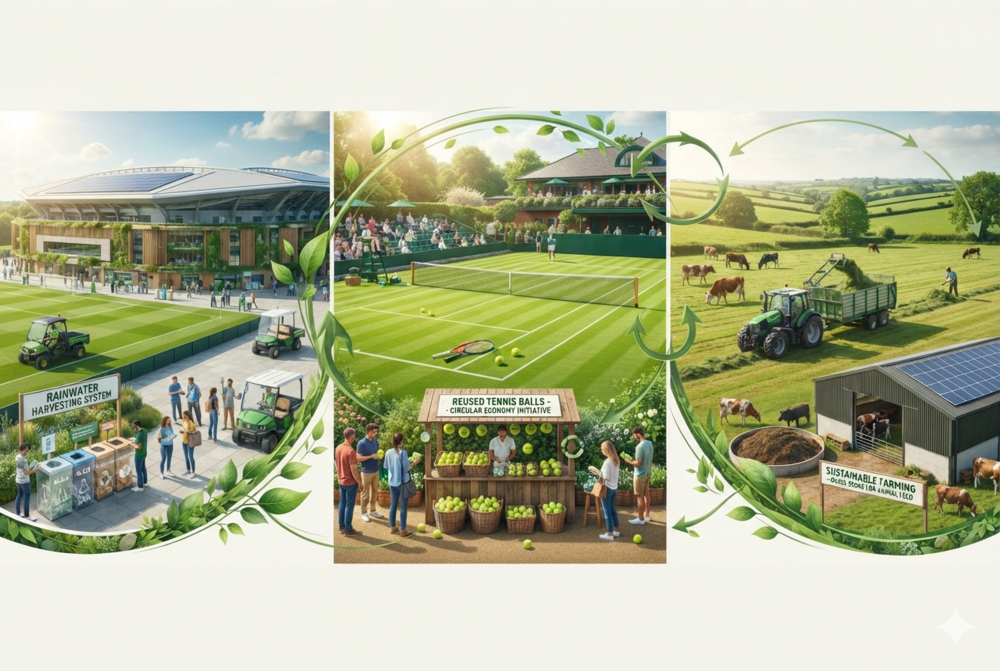
One example actually came from an episode of Clarkson’s Farm. Jeremy Clarkson visits the Netherlands to see how Dutch farms are embracing circular economy principles. One farm collects grass clippings from local football pitches and uses them as cattle feed. It also takes surplus food from nearby towns that would otherwise go to waste.
What one organisation no longer needs becomes another organisation’s valuable resource.
A similar principle is being used much closer to home. Tottenham Hotspur Stadium separates its food waste and sends it to anaerobic digestion facilities, where microorganisms break it down to produce renewable biogas and nutrient-rich fertiliser. Rather than paying for waste disposal, the material is given a completely new purpose.
The lesson for businesses is simple. Before throwing something away, ask whether somebody else could use it. Equally, is there another organisation’s by-product that could reduce your own costs? The circular economy isn’t always about expensive technology; often it’s simply about connecting the dots.
Another example that caught my eye was at Wimbledon itself.
As we wandered around the grounds, my friend (a much more enthusiastic tennis player than me) spotted a stand selling used championship tennis balls. Four balls that had been used by professionals earlier that day were selling for just £6. He immediately pointed out that buying four balls of similar quality from a sports shop would typically cost between £15 and £20.
It surprised us. Wimbledon could almost certainly charge much more.
After looking into it, though, it makes perfect sense. Professional tennis balls are replaced after the first seven games and then every nine games after that, meaning they are often only used for around 20 to 30 minutes of match play. Rather than discarding thousands of perfectly usable balls, Wimbledon gives them a second life by selling them at an affordable price.
Any balls that remain unsold are either recycled or donated to wildlife charities, where some even become homes for harvest mice.
It’s a brilliant example of sustainability creating value for everyone involved.
It’s also one of the best examples of sustainability in sport, demonstrating how reuse and circular thinking can create benefits for organisations, consumers and charities alike.
Wimbledon reduces waste, raises money for charity, spectators get a unique souvenir and perfectly usable equipment stays in circulation for years longer.
Finally, there’s the issue of plastic waste.
A documentary I watched a while ago highlighted the growing problem of plastic pollution in our oceans. Since then, we’ve seen some fantastic innovations to tackle it, including within sport itself.
Adidas partnered with Parley for the Oceans to produce football shirts made from recycled ocean plastic. Clubs including Manchester United, Real Madrid, Bayern Munich and Juventus have all worn kits made using plastic recovered from beaches and coastal communities.
Something that was polluting our oceans has been transformed into high-performance sportswear worn by some of the biggest clubs in the world, another great example of how sustainability in sport continues to drive innovation and change.
It raises an interesting question for businesses. If your organisation uses plastics or other raw materials, have you explored whether recycled alternatives could achieve the same outcome while supporting a more circular supply chain?
Not every sustainability success story is about recycling. Sometimes it’s simply about using less.
Many professional football clubs and golf courses now harvest rainwater from roofs and surrounding land to irrigate their pitches and courses. Instead of relying entirely on treated mains water during dry spells, thousands of litres of rainwater are captured, stored and reused.
It’s a relatively simple idea, but one that reduces water consumption, lowers operating costs and makes better use of a free natural resource.
Businesses can ask themselves the same question. Are there utilities or resources you’re paying for today that could be used more efficiently? Whether it’s water, heating, lighting or electricity, small improvements often add up to significant long-term savings.
One of my favourite examples comes from the Tour de France.
Professional cycling generates a huge amount of waste through drinks bottles, food wrappers and energy gel packaging. Rather than accepting that litter was inevitable, the organisers introduced designated “Green Zones“. Riders are encouraged to discard their waste only within these areas, where volunteers can quickly collect and recycle it.
Nothing about the race changed.
The bikes didn’t change.
The riders didn’t change.
The organisers simply made it easier for people to do the right thing.
Businesses often face the same challenge. Sustainability isn’t always a technology problem; it’s frequently a behavioural one. Sometimes the biggest improvements come from making the sustainable option the easiest option.
Sport plays a huge part in all of our lives at R2G, so it’s encouraging to see so many organisations thinking differently about sustainability. None of these examples will solve climate change on their own, but together they demonstrate a different mindset.
Every organisation produces waste.
Every organisation consumes resources.
Every organisation has processes that could be improved.
The challenge isn’t whether opportunities exist, it’s whether we’re looking at our operations through the right lens to spot them.
Sometimes the biggest savings aren’t hiding in expensive new technology. They’re found by making better use of what you already have, changing a process or finding value in something that others no longer need.
That’s exactly what sustainability in sport demonstrates, and it’s a mindset that businesses can adopt in their own operations.
After all, if a Wimbledon tennis ball can find a second life after just 20 minutes of professional play, what opportunities might be hiding within your own organisation?


© 2025 R2G LIMITED. All rights reserved | Website by Creativefive | Company number: 15826171 | Registered address: The Office, Gothic House, Barker Gate, Nottingham NG1 1JU | info@r2g.co.uk