
Electricity is a fundamental input cost for every business, yet few understand how its price is determined. Over the past few years, UK businesses have seen unprecedented volatility in their energy bills, driven by a combination of market, regulatory, and geopolitical factors.
This paper explains how electricity is bought and sold, why prices rise and fall, and what business owners can and cannot control when it comes to their energy costs.
Electricity passes through several hands before it reaches your premises. Consumers-both residential and commercial-purchase electricity in the retail market from a supplier, sometimes via a broker. That supplier buys electricity from generators in the wholesale market and arranges for it to be delivered through the National Grid and local Distribution Network Operators (DNOs).
Historically, the UK relied on large centralised power stations-coal, gas, and nuclear-connected directly to the high-voltage transmission network. Power flowed one way, from the power station to homes and businesses.
Since the early 2010s, however, government incentives such as the Feed-in Tariff (FIT) have encouraged small-scale renewable generation. Today, roughly 29% of generation capacity is classed as embedded generation, meaning it connects to local distribution networks instead of the transmission grid.
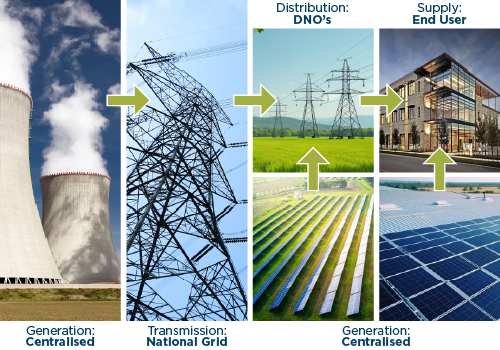
An easy analogy is the road network:
Your electricity bill covers two broad categories:
On average, non-commodity charges make up around three-quarters of a business electricity bill. These include charges for using the grid, subsidies for renewable energy, and fixed daily fees.

In the wholesale market, electricity suppliers and generators trade in 30-minute blocks. Prices change constantly-higher during periods of strong demand or low renewable generation, lower when the grid is well supplied.
The retail price paid by a business is an average of these volatile wholesale prices plus all non-commodity charges. Retail prices are therefore much smoother and respond to market trends with a delay.

Wholesale prices are highly sensitive to short-term and long-term factors:
Non-commodity costs, by contrast, are more stable and set annually by regulators. These charges are indexed to inflation and published in advance, allowing better forecasting.


The single most influential factor on your electricity cost is when your supplier buys energy on your behalf.
Wholesale markets are traded months or years ahead. If your supplier purchases energy when market prices are high, that cost is locked into your fixed contract. For example:
That’s a 7 p/kWh (50%) difference purely based on timing.

This makes comparing energy costs between businesses or sites difficult-one site’s contract may have been signed when the market was twice as expensive as another’s.
For that reason, every business should review its energy procurement strategy to ensure purchases are timed as effectively as possible.
While you can’t avoid these charges, understanding them helps explain regional and supplier price differences.
Electricity prices also depend on where your business operates.
Regional “postcode lottery” pricing stems from:
For example, comparing two locations in England such as Thurrock and Wigan, the same business could pay around 5% more for electricity in one location purely because of regional network differences.
Unfortunately, these are fixed costs beyond customers’ control.

Understanding the factors behind your electricity costs can help you make smarter decisions.
While no business can control global gas prices or government levies, you can manage:
The more informed your decisions, the better you can protect your business from price shocks.
Electricity pricing in the UK is complex-shaped by global fuel markets, local network costs, and national policy decisions.
For SME owners, the key takeaway is that timing and awareness matter. By understanding what drives electricity prices and planning procurement strategically, businesses can reduce risk, control costs, and support a more sustainable energy future.
R2G can help you navigate the landscape and support you on your procurement journey- get in touch today!


© 2025 R2G LIMITED. All rights reserved | Website by Creativefive | Company number: 15826171 | Registered address: The Office, Gothic House, Barker Gate, Nottingham NG1 1JU | info@r2g.co.uk